
"], "filter": { "nextExceptions": "img, blockquote, div", "nextContainsExceptions": "img, blockquote, a.btn, a.o-button"} }">
Heading out the door? Read this article on the new Outside+ app available now on iOS devices for members!
>","name":"in-content-cta","type":"link"}}">Download the app.
In a study Published in the British Journal of Sports Medicine, looking at seven thousand runners’ reasons for not finishing an ultramarathon after reporting an illness in the days leading up to the race, Respiratory Dysfunction topped the list.
Kaitlyn Yonke, an athlete for Speedland and the head coach for the Colorado-based company Run Infinite, experienced this firsthand at the 2023 Run Rabbit Run 100 Mile Race.
“I had a little cough in the week leading up to the race but thought I would go for it anyway,” Yonke explains. As she got deeper into the race, completing the first significant climb shortly behind the lead group, she struggled to catch her breath and needed to walk hills that would usually be runnable. “I knew something was wrong in my body when I rolled my ankle on an easy descent,” says Yonke.
As a runner who is in tune with her body, she knew it was far too early to feel that much fatigue or lack of control. For that reason, she dropped from the race nineteen miles in.
Yonke’s fatigue was caused by oxygen debt, or the needed amount of oxygen to pump blood to her muscles being less than what was available to her at the time. Working muscles require adenosine triphosphate (ATP) to obtain energy, which requires high concentrations of oxygen to move to the firing muscles. As a body fatigues and begins to leave homeostasis, the central nervous system will override the activity and send oxygen and blood to support survival, usually pumping blood to the heart. With less oxygen, the muscles will feel weak or fatigued, and an athlete might struggle with coordination.
As it turns out, Yonke’s body was working overtime, “A few days later, I went to urgent care and found out I had bronchitis. I have no idea what I would have done to myself if I had forced my body to push through the night and finish the race,” she says.
While it is a common experience to not feel well during a taper to a race or at any given time during a training cycle, respiratory disorders are cited as one of the top causes of morbidity in otherwise healthy endurance athletes. It is crucial that athletes consider the top three causes of respiratory distress: genetic factors, illness, and the environment.
RELATED: Exploring the Connection Between Mental Health and High Altitude
Table of Contents
Genetic Factors Contributing to Respiratory Health
Asthma
Asthma is a chronic condition that approximately one in thirteen Americans experience. The hallmark sign of asthma is inflammation of the respiratory pathways, which constricts breathing. Irritants such as pollen, smoke, cold air, or exercise can increase the risk of an asthma attack for an individual.
David Kingston, a physician’s assistant at the Allergy, Asthma, Immunology Center of Alaska and an avid cyclist and runner, explains. “Asthma has a lot of triggers, and 90 percent of people with asthma will find difficulty in exercise.” He goes on to say that this has both physical and mental effects. “Limited airflow also limits exercise tolerance and will decrease what an athlete is capable of, making them less eager to get out and exercise.”
RELATED: What Makes Training High-Quality—or Not?
Exercise Induced Bronchoconstriction (EIB)
Renamed from exercise-induced asthma, bronchoconstriction displays the same effects as asthma but only occurs during exercise. A recent study shows that 20 percent of the population have instances of EIB without any other asthma symptoms occurring in their life.
Dr. Nick Tiller, a sports scientist and researcher with Harbor-UCLA based out of Montreal, Canada, explains that EIB is more common for athletes who live in cold, dry climates. “The airways have to work harder to warm the air, which causes dehydration, leading to constriction and inflammation and constriction.” While the airways return to normal within a few hours after exercise, there can be the potential for lasting effects.
In the [paper “Potential Long‑Term Health Problems Associated with Ultra‑Endurance Running: A Narrative Review,” coauthored by Dr. Tiller, it is stated that “endurance athletes are potentially at a greater risk of EIB owing to high levels of pulmonary ventilation sustained in training.” For that reason, ultrarunners or endurance athletes should be more aware of their body and how it responds to training.
RELATED: Should I Tune In or Tune Out During My Run?
Exercise-Induced Laryngeal Obstruction
In runners, a phenomenon that presents similarly to EIB is exercise-induced laryngeal obstruction (EILO). “Often, patients come in complaining about not being able to take in a full breath when they start exercising,” Kingston says. EILO is caused by a narrowing or an inappropriate obstruction of the vocal fold. Often, this is diagnosed as Vocal Cord Obstruction, which Kingston describes as unnatural movements of the vocal chord, leading to the area becoming inflamed. “This can hinder an athlete’s ability to run,” he says,“but with the work of physical or occupational therapists, or even speech pathologists, we can work to fix the issue.”
RELATED: Debunking 7 Common Recovery Myths for Trail and Ultrarunners
Illness
Cold and Flu
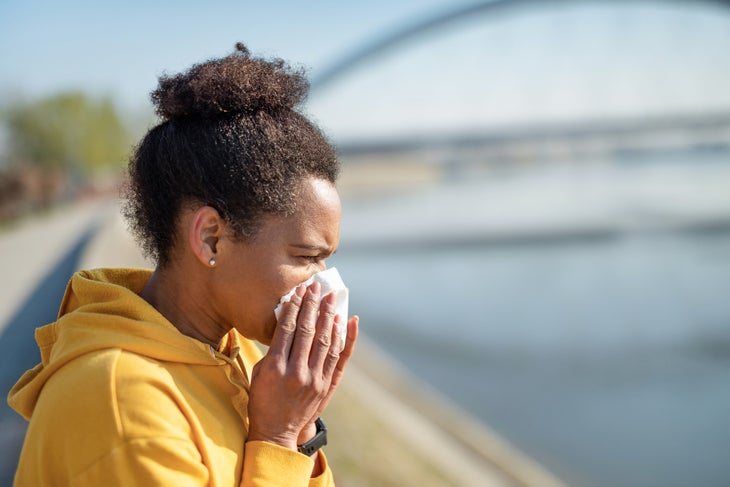
The common cold and flu significantly contribute to restricted breathing or exasperated exercise-induced issues. According to the Mayo Clinic, if an athlete is experiencing congestion symptoms above the neck, exercise at a low or moderate level should not cause any damage. However, as congestion is found below the neck, such as in the chest, exercise is not recommended.
Yonke, who coaches high-performing trail and ultra runners, does not encourage her athletes to return to exercise until they feel at least 90 percent better after a “below-the-neck” illness. “A dry cough while running is fine,” she explains, “but it is better to take time and make sure that you are healed than to deal with the lasting effects of damaging yourself from returning too early. Yonke, a team coach for Run MS, recommends staying away from public gyms or workout spaces for at least one week while recovering from an illness to protect those around you.
RELATED: How Your Menstrual Cycle Affects Recovery from Training
COVID-19
Research to fully understand how COVID-19 affects the respiratory system is still developing, while few with lingering symptoms are receiving medical intervention.“Long-term COVID is a real thing; we are seeing otherwise healthy individuals experiencing long-term effects,” says Dr. Tiller, author of A Skeptics Guide to Sports Science. He goes on to explain that it is not just the lasting symptoms that affect an athlete, but the inability to train, deconditioning an athlete to no longer feel like their pre-COVID self.
Kingston agrees with this point, stating that the lasting effects of COVID-19 can exacerbate the already-existing symptoms of asthma or EIB in an athlete, making existing conditions worse. Kingston also encourages that, through treatment and recovery, there can be significant improvements made.
Environmental Considerations
Seasonal
As stated earlier, cold, dry air can dry out the throat as the body works to warm the airways. Some athletes might also experience an increase in mucus production, coughing after the run, and airway restriction. If those side effects occur, Dr. Tiller recommends that an athlete prioritize long-term health and move their workouts indoors, especially those at a high intensity. Otherwise, it is recommended to use a thin face mask, such as a Buff, to act as a personal humidifier during the run.
Kingston, who works with Nordic skiers and endurance athletes who train through the Alaskan winter, also encourages runners to warm up indoors or very gradually outdoors during the cold winter months. “I always encourage athletes not to make huge changes in their training during the winter,” he says. “It is better to ease yourself in through the fall and gradually prepare for higher intensity as the weather gets colder.”
RELATED: Should You Run in Smoky Air? Probably Not.
Climate Change
There is a correlation between decreased air quality and respiratory health issues. Changes in weather patterns, decreased air quality, and wildfires on the rise all contribute to higher instances of respiratory dysfunction.
Indoor and Outdoor Pollutants
More than 100 million people in the United States are already living with bad air quality. With warmer air, there is expected to be an increase in particulate matter (PM), otherwise known as air pollution. Days with poor air quality are measured on the Air Quality Index (AQI), with recommendations not to exercise outdoors when the index goes beyond 151.
Wildfires
With higher instances of drought and increased temperatures, wildfires and their lasting air quality effects are on the rise. Wildfire smoke can stretch for hundreds of miles and is linked to increased respiratory illnesses. Generally, the nose does the majority of the work when it comes to filtering the air we breathe; however, when exercise becomes more vigorous and an athlete starts breathing from their mouth, there is less filtration. As Dr. Tiller points out, there is no formal guidance as to when races should be canceled due to wildfire smoke, and athletes often will need to decide on their own as to whether they think it is wise to race in poor conditions.
According to Colorado State University, AQI is 50-100; some populations with preexisting conditions, such as asthma, EIB, or severe allergies, will want to avoid exercising outdoors; however, the general population will likely be okay to continue on with their normal routine. As the AQI climbs to 101-150, sensitive populations are encouraged to avoid any outdoor activity, and those without existing conditions are encouraged to decrease workout intensity and duration of the workout, especially if any coughing or shortness of breath occurs. If AQI reaches 151-200, any vigorous outdoor exercise is discouraged; while wearing a filtration mask might make some exercise more durable, all intensity should be extremely limited. With an AQI above 200, workouts should be moved indoors altogether to avoid irritation of the airways.
Airborne Allergens
The changing climate is lending itself to longer springs and summers, causing warmer weather, changes in precipitation, and higher concentrations of carbon dioxide. All of this will increase individuals’ exposure to allergens. As allergy specialist Kingston explains, because seasonal allergies primarily affect the sinuses, it causes athletes to spend more time breathing out of their mouth, which leads to dehydration of the airways. Dehydration causes constriction and inflammation in an already irritated airway, limiting performance tolerance.
RELATED: The Connection Between Heart Rate Variability and Mental Health
Promoting Respiratory Health
Buyer Beware
While the respiratory system can be protected from irritants and illnesses, it is not as trainable as the cardiovascular system. “Most athletes, by default, will have a strong respiratory system,” explains Dr. Teller, who co-authored the paper “Distinguishing science from pseudoscience in commercial respiratory interventions: an evidence‑based guide for Health and exercise professionals.” The paper goes on to explain that because the health and wellness industry is less regulated, it is easy for industries to make claims for improving lung function and health without any scientific backing. This is especially prevalent in a post-COVID-19 world.
RELATED: Pregnancy, Parenthood and Training For Ultras
Learn the Triggers
The best thing an athlete can do for their long-term health is to get to know their body and what might irritate their lungs. Moving workouts indoors when air quality is poor, allergens are high, temperatures are cold, or while recovering from an illness are all important ways to ensure long-term health. Kingston recommends seeking professional support with any lasting symptoms. “Generally, from a professional standpoint, the more objective data we have, the better, she says…” He goes on to get tested and has documentation of treatments to find lasting solutions.
Dysfunction in the respiratory system leads to muscular fatigue, leading to declined performance and recovery. While the system cannot be trained or conditioned like other systems in the body, an athlete can improve function by avoiding illness and being aware of environmental stressors. Avoiding working out when the AQI is high, covering the mouth and nose in cold weather, and staying up-to-date with vaccinations are proven ways to protect the respiratory system.




