
In the cold season, air quality turns worse for the 13 million living in country's second-largest city
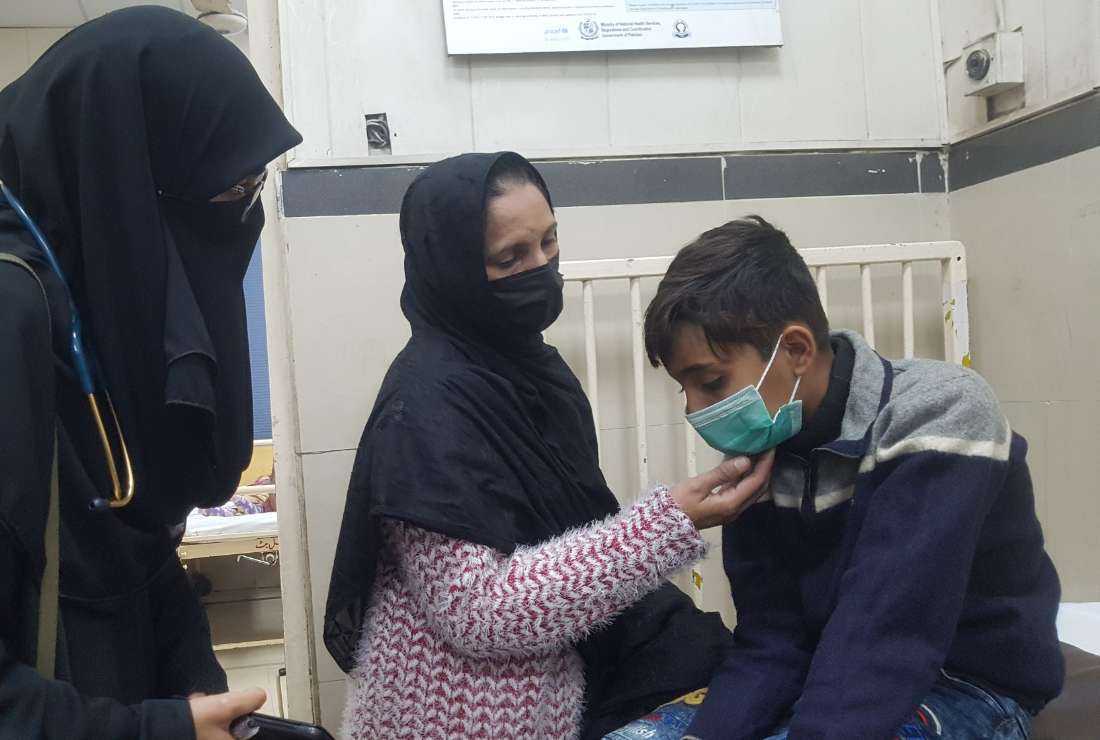
Abdul Anas with his mother Shaista Mariam (center) in hospital as a doctor looks on. (Photo: Supplied)
For 14-year-old Abdul Anas, who lives in Pakistan’s second-largest city, Lahore, every breath is a struggle in this winter.
The sixth grader had to skip a midterm exam on Dec. 11 after toxic gray smog spread across the city, causing him severe breathing problems.
A spike in respiratory diseases is common in Lahore, the capital of Punjab province when the cold season begins in October. But this year, fine particles in the air of less than 2.5 micrometers in diameter, known as PM2.5, have been particularly bad.


Lahore, once known as the city of gardens, currently holds the dubious distinction of being the second most polluted city in the world, with an Air Quality Index (AQI) of 298 in December.
An AQI level of 150-200 brings discomfort to patients with asthma, and people with lung and heart ailments.
Anas could barely breathe when he was rushed to the pediatric emergency unit at Sir Ganga Ram Hospital on Dec. 11.
“I can’t breathe. Factories should stop operating,” Anas says, holding an inhaler in one hand. The medical device has been his constant companion since he suffered a massive asthma attack.
Winter worsens pollution
Ever since, whenever Anas goes to school, which is 30 minutes away from his home, he wears a protective mask.
Anas had a severe chest infection in childhood that made him vulnerable to pollution.
Harbanspura, the area where he lives, is a semi-commercial area in Lahore.
Lahore city houses many manufacturing, textiles, and pharmaceutical units and is surrounded by rural areas where the practice of stubble burning after the harvest season is common.
Winter worsens the air quality as the pollutants and smoke stay in the lower level of the atmosphere without moving up because of the cold air above.
Sir Ganga Ram Hospital has been receiving more than 20 children with breathing problems daily.
Some 60 percent of pediatric patients are victims of air pollution, according to Doctor Sba Naeem, a senior doctor at the hospital.
“Smog does not affect us directly but is a risk factor for those with breathing problems,” he noted.
To deal with the problem, the provincial government has pressed into service mechanical sweepers to wash the dust off the roads in Lahore.
'Day laborers most affected'
Punjab province is also planning to carry out an artificial rain experiment, costing 350 million Pakistan rupees (over US$1.2 million). According to media reports, the cash-strapped nation is banking on Chinese experts to help with the cloud seeding exercise.
The state-owned Environmental Protection Agency raided 6,297 industrial units in October and found most of them breaking the law.
The agency downed the shutters of 1,011 units and slapped a fine of over 100 million rupees after registering 469 cases.
The state-owned Provincial Disaster Management Authority declared smog a calamity in Punjab province and closed schools, colleges and universities for two days, starting Nov. 24.
Currently, only bicycles are allowed on Central Mall Road in Lahore on Sundays.
Fifty-five-year-old Catholic Shareef Masih, who works as a rickshaw driver, is fed up with the enforced holidays.
“We pray to find a job. Our livelihood is outdoors and the government should think of laborers like us,” said Masih who started to wear a face mask in the hope of surviving the cold season.
“It feels odd as I am not used to it,” says the father of four. But he has little choice as he has a constant cough and a burning sensation in his chest.
Anber Raheel, director of environmental policy and planning at the Environment Protection Department in Punjab, says that religious minorities are "among the most vulnerable group" as they survive as daily laborers.
Experts and activists blame the pollution on the increasing of motorized vehicles, ill-planned development, and deforestation. Punjab lacked a comprehensive climate strategy to deal with the problem, they add.
Raheel said the average life expectancy of people in Lahore was decreasing every year.
The Christian mite
Anas' mother, Shaista Mariam, is worried about her son's health. "My child is sick because of the failure of the government. It is playing with the lives of our children. The city officials need to wake up,” she told UCA News.
Saima William, who heads the Climate Action Program of the Islamabad-based Centre for Peace and Development Initiative, said the problem cannot be dealt with just by introducing bicycles.
“Our society is not the one where women can ride bicycles freely. A multidimensional approach is needed to reverse smog,” she demanded.
“Ending stubble burning and putting curbs on industrial units" can prevent pollution to a greater extent, she told UCA News.
Bishop Nadeem Kamran of the Church of Pakistan blamed the decades-old political and economic instability in the country for the air pollution.
“Protests and unrest are major environmental hazards. Tear gas and smoke from burning tires move from higher to lower areas and the innocents suffer,” he observed.
“Housing societies are eating up agricultural land. The powerful are privileged to hunt the endangered species," he added.
His diocese postponed a convention last month, citing health hazards due to smog.
He wants Christians to know that "caring for the Earth is our first God-given responsibility."
Archbishop Sebastian Shaw of Lahore diocese on Nov. 10 celebrated the completion of the "one million tree plantation campaign" by papal charity Caritas Pakistan. The tree plantation was launched in 2020.
“Pope Francis has repeatedly reminded us of the hazards posed by air pollution,” noted the archbishop.



Dear reader,
November begins with the Feast of All Saints. That month will mark the beginning of a new UCA News
series, Saints of the New Millenium, that will profile some of Asia’s saints, “ordinary” people who try
to live faithfully amid the demands of life in our time.
Perhaps the closest they will ever come to fame will be in your reading about them in UCA News. But they
are saints for today. Let their example challenge and encourage you to live your own sainthood.
Your contribution will help us present more such features and make a difference in society by being independent and objective.
A small donation of US$5 a month would make a big difference in our quest to achieve our goals.

William J. Grimm
Publisher
UCA News
Latest News




