Submitted Art
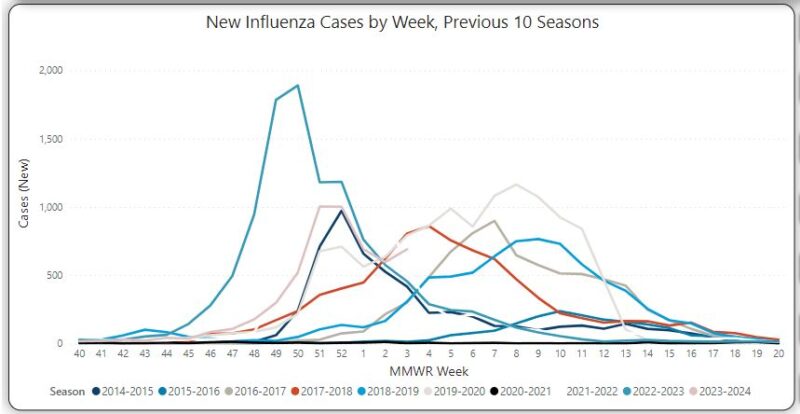
The most recent influenza data from North Dakota Health and Human Services shows last season’s peak in December 2022. The current season shows a later start to influenza activity but epidemiologist Levi Schlosser said trends aren’t expected to trend downward anytime soon. Graphic from North Dakota Health and Human Services.
As of the last week of December, North Dakota saw a total of 218,348 influenza vaccines administered.
Levi Schlosser, respiratory and syndromic surveillance epidemiologist for the North Dakota Health and Human Services’ Division of Disease Control, said was a considerable dip from the last flu season. Only 54% of seniors 65 and older have received the shot but from ages 19-49 that number is down to 19%.
Schlosser said flu activity markers have started to increase in the most recent weeks. More individuals are seeking medical care for their symptoms and the state is seeing higher cases of hospitalizations and deaths due to influenza.
He said Health and Human Services is seeing lower vaccination rates than what they would like to see, which may contribute to an influenza rise in the upcoming weeks.
The last week of December, N.D. saw 1,004 lab-confirmed cases of influenza, five of which were seen in Pierce County. Though statewide cases are seeing a dip from the previous season, which saw 1,890 cases the same week, Schlosser said it doesn’t mean numbers are going to trend downward anytime soon.
Typically the state will have influenza activity peak between February and March, however, in most recent seasons Health and Human Services has seen the peak happening earlier, toward the end of December.
Schlosser said each flu season is a little different but the state could see trends returning to what used to be considered typical.
According to the most recent influenza report from N.D. Health and Human Services, 3.95% of statewide outpatient care is providing care to individuals with flu symptoms.
“Influenza can be a very mild illness but it can also be very severe and cause a really wide range of symptoms for those who are ill. It’s not just influenza but it’s also other respiratory bugs like RSV, or respiratory syncytial virus, and COVID-19,” Schlosser said.
Shared symptoms between the three illnesses include fever, cough, shortness of breath and fatigue. He said severe symptoms in very young children, such as body aches and fatigue, can be difficult to detect but to look out for hard breathing and flared nostrils.
Schlosser said individuals who are at high risk, such as those who are very young or very old, or individuals with underlying health conditions, should consider talking to their healthcare provider sooner to seek antiviral treatment to prevent illness from developing into pneumonia.
Last flu season there were 482 flu and pneumonia deaths which currently sits at 262 for this season, according to the most recent report.
Schlosser said preventing the spread of illness is important, starting with staying up-to-date with vaccines. Other important practices include washing hands with antibacterial soap, staying home from work and school if an individual is ill and making sure coughs and sneezes are covered.