
"], "filter": { "nextExceptions": "img, blockquote, div", "nextContainsExceptions": "img, blockquote, a.btn, a.o-button"} }">
New perk! Get after it with local recommendations just for you. Discover nearby events, routes out your door, and hidden gems when you
>","name":"in-content-cta","type":"link"}}">sign up for the Local Running Drop.
The science is clear: sleep is essential for optimal running, recovery, and life in general. And with one in three Americans using wearable tech to track fitness and health, it’s clear that people crave data now more than ever—specifically, sleep data. But when you wake up and check your watch for all the details about how you slept the night before, you might not understand exactly what you’re reading.
In today’s high-tech age, most sleep trackers work the same way—though their accuracy is a spectrum. Each device uses a different algorithm, which makes results vary. That being said, many trackers contain accelerometers (small motion detectors), and photoplethysmography (PPG). Woah. Now that’s a word!
PPG is an optical technique using a tiny light to shine into blood vessels and reflect information back into the watch like heart rate, blood volume changes, and sleep stages. Accelerometers measure how much movement there is during the sleep cycle, which is helpful to track if you’re a restless sleeper.
Though there are a plethora of sleep trackers on the market, in this analysis, we’re focusing on Garmin specifically. All Garmin watches have sleep tracking capabilities, and certain versions, including the Venu 2 series, the fēnix 6, the fēnix 6 solar series, the Descent MK2 series, the tactix Delta series, the Enduro, the Forerunner 745, the Forerunner 945, have an insight called Sleep Score.
With the sleep tracking functionality built into our watches, how can we capitalize on the data to aid our running?
Table of Contents
Stages of Sleep
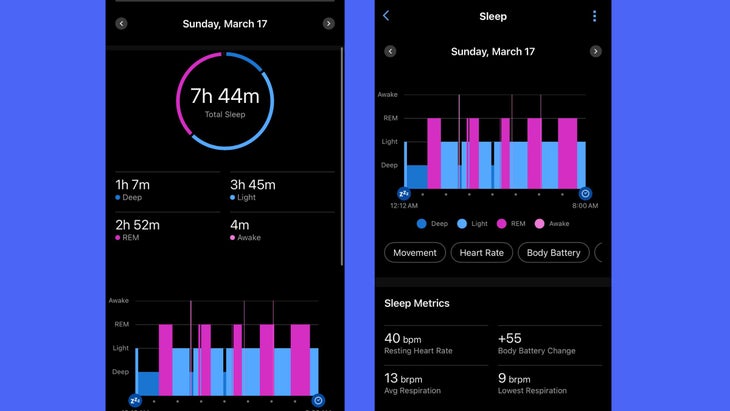
A sleep tracker will tell you how long you’ve spent in each stage of sleep: deep sleep, light sleep, and REM (rapid eye movement). Sleep specialists, like clinical psychologist and sleep medicine expert Dr. Michael Breus, further delineate the stages (except REM) to the label of non-REM sleep, categorizing them NREM 1, NREM 2, NREM 3, and REM. Your watch categorizes your sleep into these stages by compiling things like breathing, heart rate, and movement.
“These estimates are based on things the watch knows,” Breus says. “For example, we know that the heart rate slows as you progress through the stages. So when it measures your heart rate, it can eventually estimate your sleep stage.”
You typically go through four to five sleep cycles during one night. One sleep cycle is one round of all four stages.
Dr. Christopher Winter, MD, is a sleep specialist, neurologist, and author of the books The Rested Child and The Sleep Solution. He says that sleep trackers can be a helpful tool, but also cautions that they may perform better at certain things than others. Namely, he warns that these watches are better at calculating your total amount of sleep, not the amount of time spent in each stage.
“I do recommend them, as the longitudinal data they can provide can be helpful,” he says. “But they are much more accurate at calculating sleep amount, and a bit less on the nose when it comes to breaking down the stages.”
Each sleep stage plays an important role in recovery:
NREM 1
You’ll notice Breus has an extra stage that isn’t included in Garmin’s data—NREM 1. This is the first and shortest stage of sleep, taking up about five percent of your overall rest. It’s the time between wakefulness and sleep, when your heart rate and breathing decrease. You might even experience something called hypnic jerks, which are involuntary muscle twitches that happen when you fall asleep.
NREM 2 | Light sleep
Light sleep makes up about 53 percent of the night and is the stage that occurs before deep sleep. Your brain waves slow, body temperature drops, muscles relax, and breathing slows even more.
“This is where other EEG things happen called spindles and k-complexes,” Breus says. “So we can identify each sleep stage. This has various biological functions, but is mainly a buffer between REM and deep sleep.”
An EEG test (short for electroencephalographic—another whopper of a word) records, measures, and analyzes the brain’s electrical activity. During light sleep, spindles and k-complexes appear as hikes or jumps in EEG wavelengths. Both of these are believed to contribute to memory consolidation and cerebrum development.
NREM 3 | Deep sleep
When you’re in deep sleep, your brain’s delta waves—the slowest recorded brain waves in humans—slow in frequency. The heart rate and breathing slows to its lowest levels and muscles completely relax.
“Deep sleep is your physical restoration,” Breus says. “It’s when growth hormone is produced for cellular repair, when the glymphatic system removes certain proteins—which can prevent Alzheimers.”
REM
Just when you thought your brain can’t get any more chill after deep sleep…You’re right. Because Breur says, in REM sleep, your brain activity is actually similar to that of an awake person. In this stage, your body is at rest, but the thalamus (a part of the brain that relays information) is constantly sending the brain cortex sounds and images that make up our dreams.
“REM sleep is your mental restoration, where you move information from your short term memory into your long term memory, and where you process emotions and dream,” Breus says.
REM lasts about 10 minutes at a time, making up about 25 percent of your sleep in total.
So is there a “king” when it comes to these stages of sleep? Should we be getting more of one than the other?
“Everyone wants more deep sleep and more REM, but it doesn’t work that way,” Breur says. “You get what you get, as long as you’re not doing anything to your body that might prevent a particular stage of sleep like caffeine or alcohol.”
Sleep Metrics
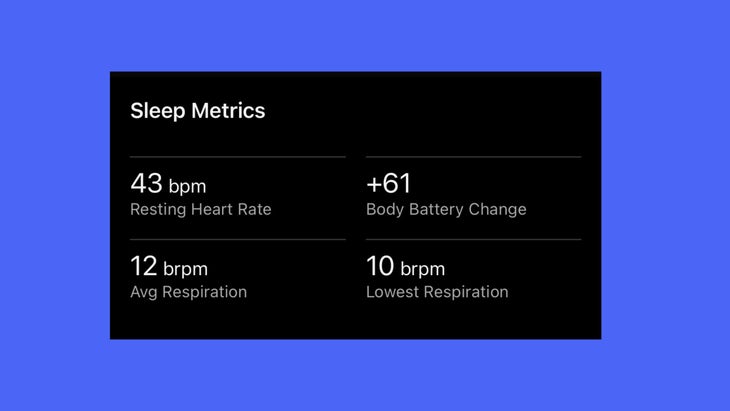
Beyond the stages of sleep and how much time you’ve spent in each of them, Garmin offers several sleep metrics: resting heart rate, body battery change, and average respiration.
“Your resting HR gives you some indication of how calm you are, and how close you are to falling asleep,” Breus says. “Most people begin to get drowsy around 60 bmp (beats per minute).”
If you notice you have trouble lowering your heart rate before bed, you might be stressed, anxious, dehydrated, have consumed too much caffeine, or are going through hormonal changes. If you find this is a pattern, you might want to look at your lifestyle choices and see what can be modified to lower your overall stress, such as following a well-balanced diet, cutting back on caffeine and alcohol, and exercising.
For an in-the-moment solution, right before bed, you can practice deep breathing exercises. The Premier Heart and Vascular Center says that deep breathing that causes your abdomen to rise and fall can calm a racing heart. Breathe slowly and deeply through the nose, and exhale through either your nose or mouth. Make sure your breaths are a consistent length, and, if it helps, hum while you breathe. This will stimulate the vagus nerve, which controls heart rate.
If your sleep tracker data reports a consistently high heart rate while you’re sleeping, you should consult your doctor. While everyone’s sleep patterns are personalized, it could be an indication you’re suffering from a sleep disorder.
Body Battery
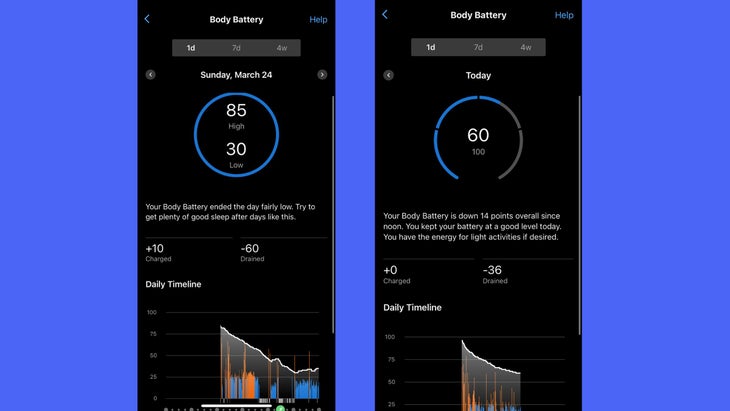
There’s also a category on the Garmin called Body Battery. While Breus doesn’t have any knowledge about proprietary categories (which a lot of smart watches have), there is an explanation on Garmin’s site:
“The Body Battery energy gauge is a feature that uses a combination of heart rate variability, stress, and activity to estimate a user’s energy reserves throughout the day. It records and displays a number from 5-100, representing the individual’s energy level.”
Because the Body Battery metric represents Garmin’s own analytics, sleep experts cannot determine its accuracy. But the basic idea is to use your own relative energy to make choices about your day. If you wake up and with a lower Body Battery reading, you might not have gotten enough sleep and could consider taking a nap, resting, and keeping your stress levels down (all of which will improve body battery). Having a low Body Battery during the day isn’t a reason not to exercise, but it’s something to keep in mind if you notice your run didn’t feel great that day, and you can give yourself some grace knowing that might be the reason.
Sleep Score
This is something not all Garmin watches have, but worth mentioning nonetheless. A Sleep Score is another insight created by Garmin, and therefore not all sleep specialists can comment on its validity. It’s meant to rate your sleep on a scale of 0-100, using all of the aforementioned data to give you an overall rating of how the night of rest went.
Sleep Score is made up of sleep duration, average stress during sleep, the amount of time spent in each sleep stage, awake time, and restfulness. Scores 90-100 are excellent, 80-89 are good, 60-79 are fair, and any scores below 60 are considered poor.
What to Look Out For
You have the data. You know what it means. Now what do you look out for?
“Inadequate sleep amount would be the number one 1,” Winter says. “If deep sleep and REM/dream sleep are consistently low, and this is coupled with feeling tired or sleepy during the day, it’s never a bad idea to speak to a sleep specialist or consider a real sleep study.”
If your Garmin reports that you’re waking in the middle of the night multiple times—even if you don’t notice it—your sleep quality might not be at its best. This might affect your day; you feel exhausted, struggle to concentrate, crave sugar, and are more hungry and stressed than usual. You may experience these effects even if you’ve technically gotten enough sleep the night before. That’s because quality and quantity have to go hand-in-hand.

“The quality of sleep matters,” Winters says. “It’s like asking ‘Does the kind of food we eat matter, or can we just eat a lot of candy and be okay?’”
Often you can improve sleep quality without an appointment with a sleep specialist by making a few adjustments. The Centers for Disease Control and Prevention have a few tips: go to bed at the same time every night and get up at the same time every morning. Stop scrolling through your phone at least 30 minutes before bed, and, if you can, don’t bring your phone to bed at all. Avoid caffeine late in the day—one study reported that consuming caffeine even six hours before bed worsened sleep quality.
Research shows that regular exercise can improve sleep quality. A study found that adults who exercised for at least 30 minutes a day slept, on average, 15 minutes longer than those who didn’t. Getting outside can also help with sleep, especially if you can get some sunshine. Exposure to natural light is proven to help regulate your sleep cycles.
Take into account the time spent in each sleep stage, but don’t stress over it unless you are also feeling tired or unwell. Winters recommends having a couple weeks worth of data before making any assumptions about your health. It never hurts to make an appointment with a sleep specialist if you’re concerned.
Ultimately, using a Garmin, or another sleep tracking device such as an Oura ring or Whoop (Breus recommends the Oura ring to his patients, saying he personally believes the sleep tracking is a bit more accurate), can help you better understand your sleep and how to improve it. But don’t let the tyranny of technology unduly influence your life. Sometimes the technology knows better than you, and sometimes it doesn’t.




