Table of Contents
Preliminary survey and construction of cues and scene
Preliminary survey of cues and scene
Due to the differences in drinking culture in different countries, it is first and foremost important to identify alcohol-related cues that can effectively induce the alcohol craving in Chinese AD patients and to construct the VR cue exposure scene that is suitable for the actual situation of Chinese AD patients.
A semistructured interview was conducted with male AD patients who were hospitalized in the Fifth Department of Psychiatry, Second Affiliated Hospital of Xinxiang Medical University from September 2021 to November 2021. The interview content mainly included the basic information and alcohol consumption of the patients, including the type of alcoholic beverages, the time of drinking, the reason for drinking, the place of drinking, and whether others were present.
A total of 40 male AD patients were recruited, and all of them met the diagnostic criteria for AD in the International Classification of Diseases, 10th edition (ICD-10). The age distribution ranged from 26 to 52 years old, years of education ranged from 6 to 18 years, cumulative drinking time ranged from 3 to 28 years, addiction time ranged from 0.25 to 17 years, and alcohol intake ranged from 76 to 636 g/day.
The results showed that AD patients preferred to drink at home (37/40) and in restaurants (33/40), preferred white wine (39/40) and beer (35/40), and preferred to drink alcohol in the evening (38/40). More than half of AD patients (25/40) said that “when eating with friends in a restaurant, especially when they were persuaded to drink, they would have strong alcohol craving”. Nearly half of AD patients (19/40) said that they wanted to drink more when they saw bottles, glasses, smelled alcohol or saw others drinking, especially when they were in a restaurant.
Based on these results, we chose the setting of multiple friends having dinner and drinking in a private room in a restaurant as a cue exposure scene.
Construction of the VR cue exposure scene
Actor selection
Although the drinking patterns of social drinkers differ from those of AD patients, most AD patients develop from social drinking. We invited 5 social drinkers to participate in the shooting of the VR cue exposure scene, 3 of whom were healthcare workers who had already worked in the Centre for Addiction Medicine for more than 5 years and had a certain understanding of the clinical manifestations and psychological activities of AD patients, to ensure the authenticity of the scene as much as possible.
Site selection
We chose to shoot in a private room in a Chinese restaurant. The specific environmental requirements of the venue are as follows: ① the area of the private room is close to 15 square metres (4 m × 4 m); ② the round turntable table and chairs in the private room are placed in an orderly manner; ③ the lighting in the private room is bright, soft and moderate, and cannot be too bright or too dark.
Plot design
The plot is designed for 5 friends who have reunited after a long absence, having dinner in a private room in a restaurant. 5 people are seated around a circular table, upon which there are glasses, cutlery, white wine, beer, food and so on. In the course of the dinner, alcohol was persuaded for various reasons, such as special occasions, years of relationship, and drinking to reduce stress. Friends pour drinks, toast and discuss the taste of the wine.
Instrument
The Insta360Pro2 panoramic camera from Insta360 Innovation Technology Co., Ltd. was used to shoot the VR cue exposure scene, and the video was processed and imported into the Oculus quest VR equipment manufactured by Oculus for playback.
Validity of the VR cue exposure scene
We recruited 30 AD patients to undergo cue exposure through this VR cue exposure scene. The results showed that all AD patients reported that the scene was realistic, and the scene effectively induced the cue reactivity of AD patients.
Participants
Sample size
The estimated sample size was calculated using the G*Power 3.1.9.7 sample size calculator. Sample size calculation was based on Wilcoxon-Mann-Whitney test (two groups), whereby the type I error was 0.05, the power was 0.8, the allocation ratio was 1:1, and the effect size was set as 0.84, which was cited from a randomized trial that compared the efficacy of virtual reality therapy and general treatment in alleviating alcohol craving in alcohol-dependent patients [41]. The estimated total sample size needed was 50, in which 25 subjects per group are required.
Recruit participants
From May 2022 to October 2022, 57 male patients with alcohol dependence who were hospitalized in the Fifth Department of Psychiatry, Second Affiliated Hospital of Xinxiang Medical University were recruited and divided into the study group (n = 29) and the control group (n = 28) according to a random number table.
Inclusion criteria: ① meet the diagnostic criteria for alcohol dependence in ICD-10; ② aged 18 ~ 50 years, Han nationality, primary school education or higher, right-handed; ③ acute withdrawal treatment ≥ 7 days, Clinical Alcohol Withdrawal Symptoms Rating Scale (CIWA-Ar) < 8; ④ normal vision or corrected vision; ⑤ normal hearing or corrected hearing; ⑥ no history of abuse of other psychoactive substances (except tobacco). Exclusion criteria: ① serious physical illnesses such as cardiovascular and cerebrovascular diseases; ② serious neurological illnesses such as epilepsy; ③ combined with other psychiatric illnesses; ④ unable to adapt to the virtual reality environment. Dropout criteria: ① subjects were unwilling to continue treatment and withdrew on their own; ② unable to complete treatment as prescribed for various reasons; ③ had missing data due to instrument failure.
The study protocol was reviewed and approved by the Ethics Committee of the Second Affiliated Hospital of Xinxiang Medical University, and all study subjects were fully informed of the purpose of the study and signed the informed consent form.
Research technique
Measurement tools
A questionnaire was developed to collect general demographic information about the patient such as age, ethnicity, years of education, employment status, etc. as well as information on alcohol use including age of first drink, cumulative duration of use, duration of dependence, type of alcohol consumed, and dose of alcohol consumed etc.
Visual analogue scale (VAS) [42]: To assess the patient’s subjective psychological craving for alcohol. The score ranges from 0 to 10 points. “0” means that there is no subjective craving for alcohol, and “10” means that the subjective craving for alcohol is extremely strong and very difficult to control.
Physiological indicators were collected by multiparameter biofeedback (Infiniti3000A, Nanjing Vishee Medical Technology Co., Ltd.), including heart rate, skin conductance and respiratory signals before and during VR cue exposure.
Procedure
VR cue exposure procedure: The researcher first briefly introduced the experimental procedure to the patients, conducted a simple training for the patients, instructed the patients on the operation method of the VR handle, and instructed the patients to choose a comfortable position to sit on the chair. Alcohol was used to clean the patients’ skin. After the alcohol on the skin surface had evaporated, the BVP sensor was attached to the patients’ middle finger, the SC sensor was attached to the patients’ index finger and ring finger, and the respiratory sensor was attached to the patients’ chest or abdomen. After starting the procedure, the connection status was checked, and the patients were instructed to relax. If the connection status was good, heart rate, skin conductance and respiratory signals were collected for 2 min as baseline physiological index data, and then the patients were asked about alcohol craving by VAS as a baseline subjective assessment. The patients were then given a VR device and given enough time to adapt to the VR environment. After they had adapted, they began to watch the VR cue exposure video. At the same time, olfactory stimulation was provided by real alcohol. During the exposure procedure, a multiparameter biofeedback device was used to collect the patients’ heart rate, skin conductance and respiration, and then the patients’ alcohol craving was asked again by VAS.
VR cue exposure was carried out in the hospital ward, and AD patients were permitted to stop the procedure at any time if they felt uncomfortable. After the conclusion of the VR cue exposure, participants were observed for about 10 min to ensure that they did not experience any significant discomfort. The sessions were conducted between 6:00 pm and 8:00 pm, as shown in Fig. 1.

Flow chart of VR cue exposure
Testing procedure: After completion of the acute withdrawal treatment, the alcohol-dependent patients were exposed to the above VR cue exposure (assessment), and the changes in VAS, heart rate, skin conductance, and respiration before and after exposure were recorded. Patients were randomly divided into the study group and the control group using the random number table method. The control group only received conventional clinical treatment for alcohol dependence, that is, benzodiazepines (such as oxazepam tablets) at the start of admission to control the acute withdrawal reaction, as well as high doses of group B and C vitamins, to correct water and electrolyte imbalances, and to improve liver function, and other symptomatic supportive treatments were given. The study group received conventional clinical treatment with the addition of VR cue exposure (treatment), 3 sessions per week (1 day apart) for 8 min. After treatment, a VR cue exposure (assessment) was conducted, and the changes in VAS, heart rate, skin conductance, and respiration before and after the exposure were recorded, as shown in Fig. 2.
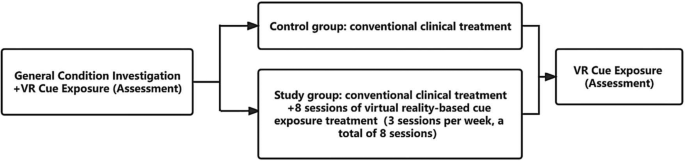
Flow chart of test procedure
Statistical method
SPSS22.0 statistical software was used for data analysis, the Shapiro‒Wilk test was used for the normality test, and the measurement data conforming to the normal distribution were expressed as the mean ± standard deviation (\(\mathop x\limits^ - \, \pm \,s\)). The independent samples t test was used for comparison between groups, and the paired t test was used for comparison within groups. Measurement data not conforming to the normal distribution were presented as median and interquartile range [M(P25, P75)], the Mann‒Whitney U test was used for comparison between groups, and the paired Wilcoxon test was used for comparison within groups. P < 0.05 was considered statistically significant.