Quebec emergency rooms are overcrowded. Capacities averaging 129 per cent on Wednesday morning across the province.
The Index Santé site, which monitors and reports occupancy rates and waiting times in ERs, says shortly after 8 a.m. that the average rate for Montreal was 139 per cent with the Lakeshore General Hospital at 216 per cent and the Montreal General at 187 per cent.
Health Minister Christian Dubé will hold a press conference at 1:30 p.m. to address the situation and the increase in respiratory viruses like COVID-19, Respiratory Syncytial Virus (RSV), and Influenza.
He’ll be joined by Public Health director Dr. Luc Boileau and the president of the Association of medical specialists and emergency medicine of Quebec Dr. Gilbert Boucher (he is also an emergency physician at the Montreal Heart Institute).
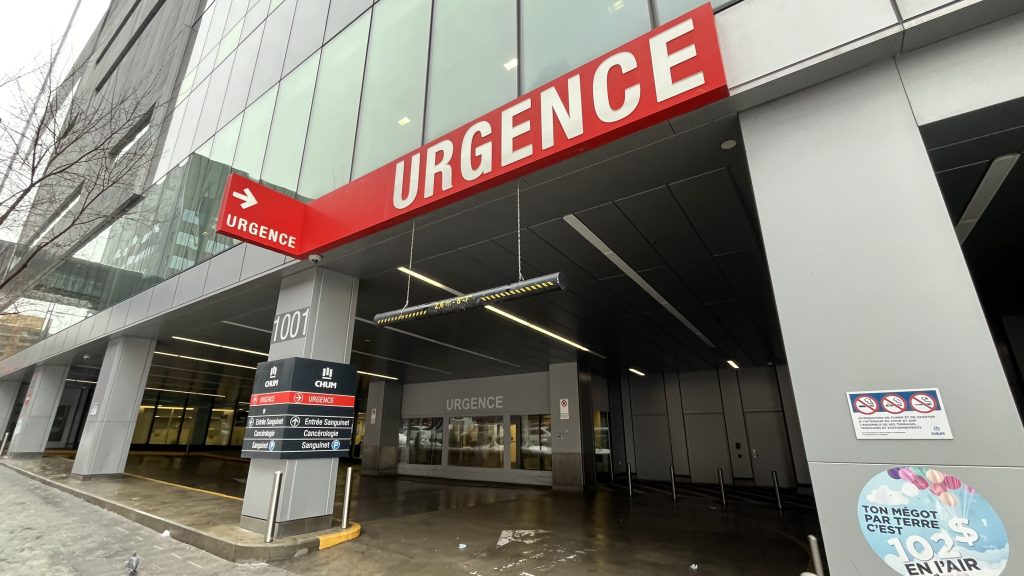
The most critical situation: in the Lanaudière region, where the occupancy of the emergency rooms of Pierre-Le Gardeur Hospital and the Lanaudière Hospital averaged 201 per cent.
In the neighbouring region of the Laurentians, the emergency occupancy rate at 161 per cent.
The rates at 169 per cent in Laval and 146 per cent in the Montérégie.
“Emergency rooms are occupied by patients that are waiting for hospital beds or don’t have anywhere else to go and they’re on the stretchers,” said Dr. Judy Morris, president of the Association of Emergency Physicians of Quebec. “A big chunk of those patients on the stretchers in emergency room are actually patients that should be up on the ward in the hospital but they’re stuck in the emergency room for a lack of space on the floor to take them in.”
She says that the situation has been difficult in many of Quebec’s regions.
“It makes working conditions and patient care very difficult for all emergency room teams,” she said.
Dr. Morris says there are solutions to solve the congestion in ERs, some even put forward by Quebec’s crisis cell.
“The big one is the overcapacity protocol of the ER meaning if is at 160 per cent, you have to share a little bit that burden, you distribute a little bit of pressure on the wards and have each department on the ward take an extra patient or an extra two patients to relieve a little bit of pressure on the emergency room,” she said. “It’s not a perfect solution. It’s only a temporary solution, but this is one of the things that needs to happen if we want to give a little bit of breathing room to the emergency room to be able to to achieve our mission, which is to take care of the acute patients coming in.”
“What we noticed is that on the ground it’s not being applied,” said Dr. Morris. “So, hopefully there’s going to be more of a strict follow up with all establishments.”
Experts say ER overcrowding is linked to an increase in the number of cases of respiratory viruses. Just before New Year’s Eve, the Quebec government called on the population to exercise caution in order to limit the transmission of these viruses and avoid applying additional pressure to the health network. The Health ministry stated that a large proportion of patients who consult the emergency room do not need to go there.
Among the examples observed on a daily basis, the ministry reported sore throats, mild coughs, gastroenteritis without signs of significant dehydration and symptoms of urinary tract infection. These health problems can often be neutralized by a consultation on the 811 telephone line or at the digital first line access desk (GAP).
Nevertheless, the ministry reminded that one should not hesitate to go to the emergency room for any health situation requiring immediate care.