NAVI MUMBAI: A 28 year old man who was suffering with rare case of Myasthenia gravis with Thymoma, got a new lease of life at Fortis hospital in Vashi after a surgery that removed his tumour. A chronic autoimmune, neuromuscular disease that causes weakness in the skeletal muscles, Myasthenia Gravis, is a rare diagnosis for patients in their 20s and 30s as it generally occurs in much older people. Coupled with Thymoma, a condition where a tumor is present in the Thymus gland which is a a lymphoid organ situated in the neck of vertebrate. A
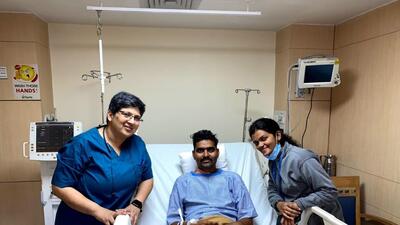
ccording to the doctors at Fortis Hospital, this is a rare case as only 10-12% of patients with Myasthenia Gravis suffer from Thymoma. Since his diagnosis eight months back, the patient had suffered severe mobility issues that were gravely impacting the quality of his life. The patient underwent five cycles of plasmapheresis after surgery.
Akash Ingale from Kurla, who is a distributor of mobile phones, got diagnosed with this rare condition around eight months back and since then his life changed. He lived at first floor and climbing the stair had got difficult for him so his wife started accompanying him. “Me and my father-in-law used to provide him support to climb the stairs. Also, as his condition worsened, I used to accompany him to his workplace and sit with him all day, which meant that my work also got hampered. He could not travel long distances independently and would always require support,” said his wife Netra who used to work in a beauty parlour.
On June 24, 2023, Ingale was admitted to Fortis Hospital, Vashi, after being diagnosed with Myasthenia Gravis with Thymoma and underwent surgery on June 26 and even now he is hospitalised post surgery. He was on multiple drug regimens, including steroids and immunosuppressant for Myasthenia Gravis, which greatly impacted his quality of life before the surgery.
A multidisciplinary team led by Dr Prriya Eshpuniyani, Consultant-Thoracic OncoSurgeon, Dr Prasad Pande, Consultant-Gastrointestinal Surgeon, Dr Pawan Ojha, Director-Neurology, and Dr Jitendra Choudhary, Sr. Consultant - Intensive Care & Critical Care treated Inagle. To decide the course of treatment, a contrast-enhanced CT scan was done pre-operatively to confirm Thymoma and associated lung damage along with poor muscle strength & respiratory issues.
After a discussion, the team decided that Video-Assisted Thoracic Surgery (VATS) or Thymectomy VATS thymectomy would offer the best possible outcome. Before the surgery, Akash also underwent three cycles of Plasmapheresis-a treatment process for autoimmune diseases. “Although a surgery for Myasthenia Gravis is quite challenging, opting for VATS as a treatment methodology was possible, as the team is experienced. In this case, a small five cm incision and a one cm incision were made on the left side of his chest and the thymus gland with the thymoma and all the fat in front of the heart between both lungs was removed. After the surgery, the patient was removed from ventilator on the table and kept on non-invasive ventilation throughout the night,” Dr Eshpuniyani said
“The patient experienced Myasthenia crisis, one day after the surgery, when he had sudden shortness of breath and desaturation leading to reintubation & ventilation. As the team had prepared for this scenario, we were able to provide a quick intervention where the patient was stabilized in a speedy manner, which helped him recover faster. Further, since he had undergone a VATS, he faced minimal problems in terms of respiratory challenges that would not have been possible in traditional surgery.” the doctor added.
“The patent underwent five cycles of plasmapheresis after surgery along with appropriate antibiotic coverage, physiotherapy, and post-operative care. After receiving these treatments, there has been a significant improvement in his muscle power and chest physiotherapy, which has helped improve his breathing and coughing capabilities, thereby strengthening his respiratory organs,” Dr Ojha said.
Married just a year back the situation was a huge challenge for Netra as well who provided all the emotional support Ingale required. Around after four months of marriage, Ingale had started showing the symptoms. “Initially, he could not raise his hands properly, and then he began facing problems moving around, including climbing up and down the stairs. He could not even eat his food properly due to mobility issues. Finally in the month of June, we visited Fortis hospital and decided on the course of treatment,” Netra added.