
A clear sky on Saturday and clearing of cloud cover did impact the air quality but the index still remained at 88.Double digit air quality index (AQI) is not unknown to Nagpur where monsoon season as well summer days see cleaner air.
The ensuing festive season and continued low temperatures prevented dispersion of toxic materials in the environment, keeping AQI in moderate to poor category. Moderate AQI causes breathing discomfort to people with lungs, asthma and heart diseases while poor AQI causes discomfort to most people on prolonged exposure.
MPCB regional officer Hema Deshpande said air quality is satisfactory at all four recording stations.
“Till precipitation happens, air quality remains clean. It all depends on atmospheric conditions and movement of wind. Dispersion should keep happening if air has to remain clean,” she said.
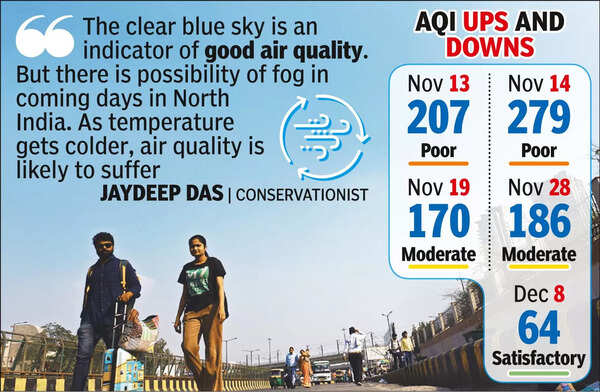
Conservationist Jaydeep Das, who keeps following AQI round the year, said the clear blue sky is an indicator of good air quality. “Rains and wind always help remove smoke or toxic particles from the air. But there is possibility of fog in coming days in North India. Second week of December is known to experience fog and colder weather. As temperature gets colder, air quality is likely to suffer,” he said.
Nagpur’s AQI had slipped to beyond 201 in poor category and reached a maximum of 279 on November 14 after cracker bursting. The time cap on bursting crackers and allowing only green ones did seem to help a lot as Nagpur’s air quality didn’t reach very poor quality as compared to other cities.
We also published the following articles recently
Delhi's Air Quality Index (AQI) reached the 'very poor' category in multiple areas on Tuesday morning, according to the Central Pollution Control Board (CPCB). The official data recorded at 07.00 am revealed an AQI of 340 in Anand Vihar, 315 in Ashok Vihar, 307 in ITO Delhi, and 332 in Jahangirpuri. Yesterday, Delhi's AQI was categorized as 'Poor'. Over the past few weeks, the capital city has been grappling with air quality ranging from 'severe' to 'very poor'.
New Delhi's air quality worsened marginally as the wind speed slowed down, with the air quality index (AQI) falling to 339. The Indian Institute of Tropical Meteorology (IITM) forecasts an improvement in AQI from Saturday due to better wind speed. According to IITM's Decision Support System, transport contributes to 15.9% of PM2.5 in the city, industries contribute about 6%, and other sources contribute 35.4%. The weather remained clear with a maximum temperature of 25.7 degrees Celsius and a minimum temperature of 9.4 degrees Celsius. The Met department predicts a slight fall in minimum temperature around December 11.




